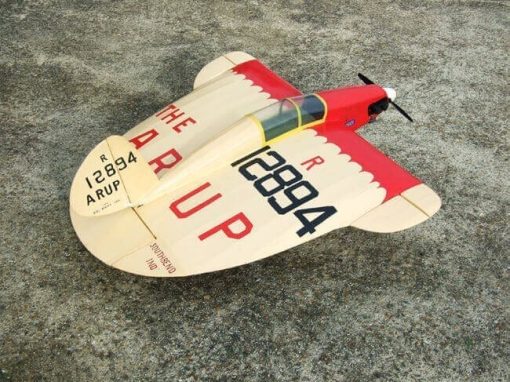
Arup S2 ‘Heel Lift’ (42″) – Additional Wood Pack
Keith Humber’s near-scale 42” span design of this 1933 ‘flying wing’ is powered by a 6.5 cc engine and 4-function R/C. Construction is all wood from the detailed 2-sheet plans. Flying characteristics are typical for this type and should be flown by experienced pilots only. The Full Size: – Design – The full-size Arup S-2 featured a straight leading edge wing with a trailing edge that tapered to the rear of the aircraft giving it a guitar pick shape when viewed from above. An M6 airfoil was chosen over its predecessor’s sharp-edged, modified Clark-Y airfoil. The large trailing edge control surfaces were mixed for pitch and roll control but were assisted by small, movable, semi-circular wingtips that could provide additional roll control. The conventional landing gear was used, faired with wheel pants. The access to the cockpit was from a belly-mounted hatch. Visibility was enhanced with celluloid panels on the aircraft’s belly. Operational history – The prototype S-2 was test flown by Glen Doolittle. The STOL aircraft could fly at up to 35 degrees angle of attack without stalling. The aircraft was demonstrated across the country at events like the Indianapolis 500 and the 1933 National Air Races. Later it was demonstrated to the Army, NACA and CAA in Washington. D.C. Raoul Hoffman left Arup after the development of the S-2 to create his own design, the Hoffman Flying Wing. Engineer Charles H. Zimmerman viewed the S-2 trials in Washington and later applied the principles to the Vought XF5U program. The S-2 was sold without an engine to a stuntman, F.F. Bowser Frakes, who performed air crashes at fairs. A Szekely radial engine removed from an American Eaglet was installed on the S-2 but did not perform well. A propeller was acquired from Milt Hatfield, who sourced the landing gear for the first S-1. Hatfield demonstrated how to fly the aircraft and it eventually crashed in a show. Images kindly supplied by Kenny Beggs and model builder Alastair Nicol